Draft (unpublished)
Shohei Ohtani's Mandala Chart
Inside Shohei Ohtani's mandala chart, the 81-square goal sheet he wrote at 16: the central goal, 8 themes, 64 actions, why 'luck' is on it, and how to copy it.
- mandala chart
- goal setting
A single sheet of paper that Shohei Ohtani filled in as a high school freshman in Japan is still the most-cited example of goal setting anywhere. This article walks through what was actually written in those 81 squares, and explains why the format works even if you never throw a baseball.
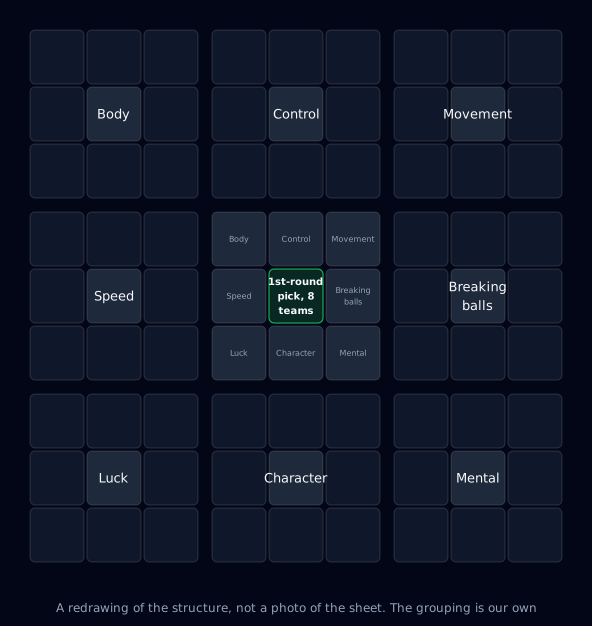
The original sheet is not reproduced here for copyright reasons. The diagram above is our own recreation of its structure, and every factual claim below is sourced. Several of the sources are Japanese-language pages; they are marked as such.
What is in Shohei Ohtani's 81-square mandala chart
Ohtani wrote the sheet as a freshman at Hanamaki Higashi High School, a baseball powerhouse in Iwate Prefecture in northern Japan, as part of a goal-setting exercise run by his coach at the time, Hiroshi Sasaki (Kaonavi HR glossary, Mandala Chart Association, both in Japanese). It is a 9x9 grid: one central square, eight surrounding themes, and 64 outer actions. Let's read it in that order.
The center square: "8 teams, 1st-round draft pick"
The center reads simply "8 teams, 1st-round draft pick": to be nominated in the first round of the Nippon Professional Baseball (NPB) draft by eight clubs.
That needs a word of explanation if you follow MLB rather than NPB. In Japan's draft, clubs announce their first-round picks simultaneously, and when several clubs name the same player, a lottery decides which one wins the right to negotiate with him. The number of first-round bids a player draws is therefore a public measure of how highly the league rates him — and eight bids on one 18-year-old would have been extraordinary.
Note what the goal is not. Not "become a pro," not "make it to Koshien" (the national high school championship that every Japanese player grows up aiming for), but a target you can score yes or no on a single evening. For a 16-year-old, it was an unusually bold thing to write down.
The eight surrounding squares: what the goal requires
The eight squares around the center hold these themes:
| Theme | Type |
|---|---|
| Body building | Physical |
| Control | Skill |
| Movement (sharpness on the ball) | Skill |
| Speed: 160 km/h (99 mph) | Skill (numeric target) |
| Breaking balls | Skill |
| Luck | Habits and relationships |
| Character | Personality |
| Mental | Mindset |
(The "Type" column is our own classification, not part of the sheet.)
The striking part: only four of the eight are directly about pitching. The other half — body, luck, character and mental — have nothing to do with throwing a ball harder.
The 64 actions: what fills each theme
Each theme is in turn surrounded by eight squares holding the actions that build it. The summary below is compiled from published reporting and commentary (Kaonavi, Parasapo Web, Mandala Chart Association, all in Japanese). It is a summary rather than a full reproduction of the sheet.
| Theme | Actions written in the sheet (summarized) |
|---|---|
| Luck | Greet people; pick up litter; keep your room clean; treat your equipment with care; respect umpires; think positively; become someone people root for; read books |
| Character | Gratitude; manners; consideration; be someone who is loved; be someone who is trusted; persistence; planning; sensitivity |
| Mental | Don't ride the highs and lows; be strong under pressure; don't get swept up by the mood; avoid streaky play; care about teammates; hold clear goals; cool head, warm heart; a will to win |
| Body building | Body care; take supplements; flexibility; range of motion; stamina; front squat 90 kg (200 lb); back squat 130 kg (285 lb); meals (7 bowls of rice at dinner, 3 at breakfast) |
| Control | Fix the inward step; strengthen the trunk; keep the axis steady; stabilize the release point; don't open the body; eliminate anxiety — items about repeatable mechanics and a settled mind |
| Movement | Hit down through the ball; release out front; create angle; don't over-muscle the throw; strengthen the wrists; lead with the lower body; raise spin rate — items about the quality of the ball |
| Speed: 160 km/h (99 mph) | Rotate around the axis; strengthen the legs; gain weight; strengthen the shoulders; trunk work; range of motion — items about raw output |
| Breaking balls | Finish the forkball; a put-away pitch for lefties; throw it with the same form as the fastball; add pitches that steal strikes — items about the repertoire |
Notice the difference in precision from square to square. "7 bowls of rice at dinner, 3 at breakfast" is a bulking instruction in the most concrete form possible — rice is the staple at every Japanese meal, so this is "eat far more than you want to," expressed as a number you can act on tonight. "Gratitude" or "don't ride the highs and lows," by contrast, are states rather than actions: you cannot check them off. For a sheet written by a 16-year-old it is remarkably complete, but it is not a flawless template. Read it as "a sheet where every square got filled in first," and it becomes far more useful as a model for your own.
How much of the sheet actually came true
The central number did not happen. At the draft on October 25, 2012, the Hokkaido Nippon-Ham Fighters were the only NPB club to name him with a first-round pick — one bid, not eight — and he turned pro with them in 2013 (City of Oshu, Number Web, both in Japanese).
One of the eight surrounding squares did come true. In July 2012, in a semi-final of the Iwate prefectural tournament in his senior year, he threw 160 km/h (99 mph) — at the time the fastest pitch ever recorded by a Japanese high schooler (City of Oshu, Number Web, both in Japanese).
Why the mandala chart format works
The reason this sheet produces results has little to do with Ohtani's talent and a lot to do with its structure.
A distant goal gets pulled down to today
"First-round pick from eight teams" was two and a half years away and, worse, an outcome decided by other people. On its own it tells you nothing about what to do this afternoon. The mandala chart breaks it down into "160 km/h," a number he could measure himself, and then down into "gain weight" and "strengthen the lower body" — items that fit into today's training session.
The number eight forces breadth
Having to produce exactly eight themes means you run out of technical answers and start looking elsewhere: body, mind, habits, relationships. That constraint is why half of Ohtani's eight squares are non-technical. The same thing happens one layer down: asked for eight ways to throw harder, you stop writing "throw more" by item four and start writing about body weight, mobility and trunk work.
Everything fits on one page, so it can be rewritten
Because all 81 squares sit on a single sheet, you can see at a glance which themes are moving and which have been untouched for a month. The Mandala Chart Association writes that Ohtani rewrote his sheet 16 times over his three high school years (Mandala Chart Association, in Japanese) — and rewriting is only possible when you can see the whole thing at once. A goal list spread over several notebook pages does not get revised the same way.
<!-- TODO(decision): Choose A: keep "16 times over his three high school years" with the attribution as written, or B: drop the number and say "rewrote his sheet repeatedly". If B, edit the sentence above and make the matching change in ja.md ("高校 3 年間でシートを計 16 枚書き換えた"). Already researched: re-checked 2026-09-23. The figure appears only on the Mandala Chart Association site (https://mandalachart.jp/wp/mandalachart — "高校3年間で計16枚書き換え、目標を進化させ続けた。"). It is absent from the same association's detailed walkthrough (https://mandalachart.jp/2390), from coverage of Hanamaki Higashi coach Hiroshi Sasaki, and from the City of Oshu pages. It stays single-source, so this is an editorial call, not a fact to be checked. -->Mapping that three-layer structure onto a year / month / week / day system is covered in the last section.
Why "luck" and "character" are on a pitcher's goal sheet
The two squares people always ask about are "luck" and "character." What are they doing on a sheet about getting drafted?
Look at what fills the luck square: greeting people, picking up litter, cleaning your room, taking care of your equipment, how you treat umpires, becoming someone people root for. Every one of those is an action he controlled. "Luck" here does not mean chance; it means deliberately becoming the kind of player people want to support. A draft pick is not decided by your fastball alone — scouts, coaches and teammates all form an opinion of you first. The sheet simply groups the behaviors that shape that opinion under one honest label.
"Character" works the same way: gratitude, manners, being someone who is trusted are all items about relationships. When you see clips of Ohtani picking up litter on a major league field, you are watching a square from that 16-year-old's sheet still in force.
"Mandala chart" vs. "goal achievement sheet"
Ohtani's grid gets called both a mandala chart and a goal achievement sheet. Those are two separate lineages that happen to overlap.
- Mandala Chart®: a thinking framework devised in 1979 by Yasuo Matsumura, founder of Clover Management Research, which fits a goal, its factors and its actions onto one page using nested 3x3 frames. The name is a registered trademark of the Mandala Chart Association (Mandala Chart Association, in Japanese).
- Goal achievement sheet (Open Window 64): a 9x9 sheet systematized by the educator Takashi Harada as part of the Harada Method. Harada himself has written that tools from his method were used with students at Hanamaki Higashi's baseball program (Nikkei Business, authored by Harada, in Japanese).
So the 9x9 format traces back to the mandala chart, while the specific sheet Ohtani filled in came out of coaching in the Harada Method tradition. This article uses both names; they point at the same piece of paper.
How to build your own mandala chart, in three steps
Here is the short version. Handling the squares you cannot fill, and running the chart month to month, is covered in the complete guide to making a mandala chart.
Step 1: Write one yes-or-no goal in the center
Following Ohtani's "8 teams, 1st round," write a single goal with a deadline and an unambiguous pass condition. One year is a good horizon. "Sign 10 new clients by March 2027" works because in March you can answer yes or no.
Step 2: Fill the eight surrounding squares with different kinds of factors
List everything the goal requires, then cut it down to eight. The trick is to do what Ohtani's sheet does: don't let skill items take all eight. Mix in body, habits, relationships and mindset. If your goal is decided by someone else's judgment, include one theme that plays the role "luck" plays on his sheet — the actions that shape how the decider sees you.
Step 3: Break each theme into eight actions
For each theme, write eight actions that answer when, what and how much. Numbers like "7 bowls at dinner, 3 at breakfast" can go straight into a calendar. Leave squares blank if nothing honest fits.
Turning the chart into a system you actually run
The three steps above need nothing but paper. Paper breaks down after that, in three predictable ways:
- Every week you copy out by hand which of the 64 actions you are doing next
- Whether you actually did them never makes it back onto the sheet
- When a new month shifts your focus, you rewrite the whole thing
Abstria is a goal management app built around exactly that reselecting and rewriting. Goals live in four layers — year, month, week, day — and the mandala screen puts this month's goal (MAP) in the center and this month's eight week-level goals (WAP) in the surrounding squares. One monthly goal carries at most eight weekly goals, the same "eight per theme" constraint as Ohtani's sheet.
Mapped onto his sheet:
| Ohtani's sheet | Abstria layer | Example |
|---|---|---|
| Center: "8 teams, 1st-round pick" | Yearly goal (YAP) | Sign 10 new clients by March 2027 |
| The 8 themes, e.g. "body building" | Monthly goal (MAP) | September: focus on referrals from existing clients |
| The 64 actions, e.g. "7 bowls" | Weekly goals (WAP, up to 8 a month) | This week: ask 5 accounts for a referral |
| (no equivalent layer) | Today's tasks (DAP) | Email Company A asking for an intro |
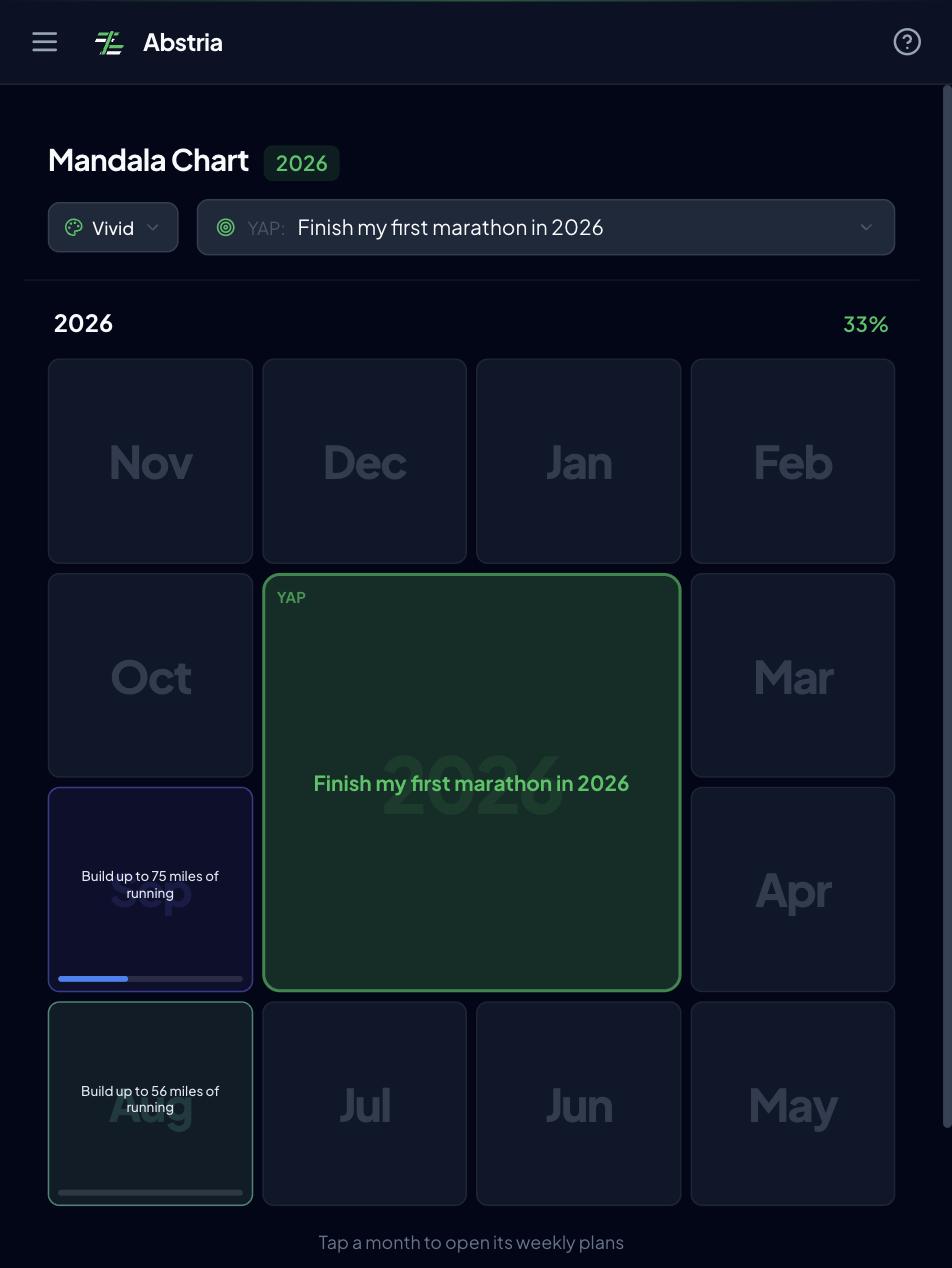
The layer that paper does not have is today's tasks. Open a surrounding square and you can add or edit the day-level tasks under that weekly goal. Completed tasks roll up into weekly, monthly and yearly progress, so "did I actually do it" comes back to the chart instead of disappearing.
You can watch the four layers move together in the demo on the Abstria landing page, no signup required. It is pre-loaded with a marathon-training example: four layers, plus a mandala where the center is this month's goal and the surrounding squares are the weekly goals. Complete today's action and the week, month and year progress updates.
See the mandala chart in action in your browser (no signup)
For alternatives, see the best apps for building a mandala chart. Abstria's Free plan includes up to 3 yearly goals and 100 active items (as of September 2026). The mandala chart and all four layers are available on Free, so you can run the three steps above without paying. See the pricing page for details.
FAQ
Q. When did Shohei Ohtani make his mandala chart?
He wrote it at age 16, during his first year at Hanamaki Higashi High School in Iwate Prefecture, Japan. It came out of a goal-setting exercise run by his coach at the time, Hiroshi Sasaki.
Q. Are the "goal achievement sheet" and the "mandala chart" the same thing?
For Ohtani's sheet, yes: the two names refer to the same piece of paper, but they come from different sources. "Mandala Chart" is Yasuo Matsumura's 3x3 thinking framework (a registered trademark); the "goal achievement sheet," or Open Window 64, is a tool from Takashi Harada's Harada Method. Both use a 9x9 grid to break a goal down, so the names are used interchangeably.
Q. Did Ohtani invent this method?
No. The mandala chart format was devised in 1979 by Yasuo Matsumura of Clover Management Research, and the sheet Ohtani filled in came from goal-setting coaching at his high school in the tradition of Takashi Harada's Harada Method.
Q. Does it work for people who aren't elite athletes?
Yes. What makes the sheet effective is not athletic talent but its structure: it breaks a distant goal down into things you can do today. Any goal with roughly a one-year deadline can be built the same way, in any field.
Q. Do I have to fill in all 81 squares?
No. Leave squares blank and move on. In Abstria too, you only register as many weekly goals as you actually need in the surrounding squares.
The fastest way to see whether the 81-square format fits you is to run one that connects down to today's tasks.
See the mandala chart in action in your browser (free, no signup)
If it clicks, run the same three steps on a goal of your own. Abstria is invite-only as of September 2026, and we're onboarding people from the waitlist in order. You can start on the free plan.
Already have an invite code? Go straight to creating your account.
<!-- TODO(release): When invite-only ends, switch the closing CTA back from /invite to /signup ("Start free"), and delete the "Abstria is invite-only as of September 2026" sentence and the "Already have an invite code?" line. Make the same change in ja.md. Trigger: the referral_pending gate in apps/web/middleware.ts is removed and /signup is reachable without an invite code (the gate is still active as of 2026-09-23). -->