Draft (unpublished)
How to Set Annual Goals: 4 Steps
How to set annual goals that survive February: pick one yearly goal, break it into monthly milestones, weekly goals, and one task for today.
- Annual goals
- Goal setting
Yearly goals don't die in February because you lack willpower. They die because there is nothing between "run a marathon this year" and "what do I do this morning?" This guide builds those missing steps in four moves.
Annual goal setting works when you break the year into month, week, and day
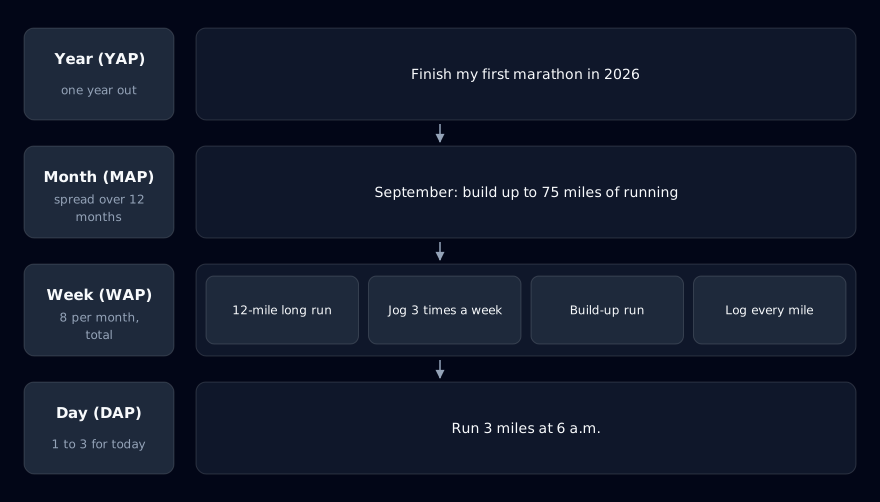
An annual goal needs four layers, not one.
- Year (YAP): one goal for the year, written so you can answer yes or no on December 31
- Month (MAP): that goal split across 12 months, each with a "this far by month-end" milestone
- Week (WAP): this month's milestone split into at most 8 weekly goals
- Day (DAP): 1 to 3 tasks for today, pulled from this week's goal
Run only a daily to-do list and you get the familiar result: busy weeks, zero movement on the thing you actually care about.
Why annual goals fall apart by February
The goal is written as a state, not as something you can do
"Get healthy" or "become fluent in Spanish" describe a state you want to be in. Neither is a goal yet. A state can't go on your calendar or your task list, and anything that never lands on either one never gets done. Step 1 rewrites the goal as a single sentence with a finish line and a deadline.
One day's slice of a year feels like nothing
Jump straight from the yearly goal to today and today's share is microscopic. You do it, and nothing feels any different. Monthly milestones and weekly goals give you intermediate finish lines — "this far by the end of the month," "this far by Sunday" — that are actually satisfying to hit (steps 2 and 3).
Nothing on the calendar forces you to look at the goal again
Motivation peaks the moment you write the goal down and declines from there. If no recurring slot exists for "am I on track, and do I need to adjust?", the goal quietly becomes wallpaper. A weekly review is that slot.
Step 1: Narrow to one annual goal (YAP)
Start with exactly one goal for the year. Every layer below it takes real work to maintain, so the number you can run in parallel is small. Break one goal all the way down to daily tasks first; add a second only if you still have room.
Look back before you look forward
Before writing anything new, answer three questions about the last twelve months.
- Which goals moved, and which didn't?
- For the ones that didn't: was it time, was it the approach, or did you never actually care?
- What would you most regret leaving untouched this year?
Anything in the "never actually cared" bucket is off the list for this year. The thing you'd most regret ignoring is your first candidate.
Write it so December 31 gives a yes or no
Turn the candidate into one sentence with a finish condition and a deadline. The test: on December 31, can you answer "did I do it?" with a plain yes or no?
| Needs work | Works |
|---|---|
| Get healthy | Finish a marathon at the November 2026 race |
| Become fluent in Spanish | Reach CEFR B2 and run one 30-minute client meeting in Spanish by March 2027 |
| Start a side business | Hit $1,000 a month in side-business revenue for three months straight in 2026 |
| Read more books | Read 24 books in 2026 and write a one-page note on each |
For goals that resist numbers — change jobs, get certified — write the deadline and what counts as done instead.
If you're freelancing, an income target is a strong candidate for the one yearly goal. The freelance goal setting framework walks through turning a revenue number into monthly, weekly, and daily work, which is a useful reference while you pick your candidate.
Step 2: Split the year into monthly milestones (MAP)
With the yearly goal fixed, write what "done" looks like at the end of each month. Those are your monthly milestones.
How you split depends on the goal.
- Accumulating goals: divide the yearly quantity by twelve. 24 books a year becomes 2 a month; 750 miles a year becomes about 60 a month. Simple — but if you know ramp-up is slow, set the first two months lower.
- Staged goals: put the phases in order. For a marathon: build a running habit, then raise monthly mileage, then add long runs, then race-specific work, then the race itself.
Here is the marathon example as a staged split.
| Month | Monthly milestone (MAP) |
|---|---|
| Jan | Run 3 miles, three times a week, for four straight weeks |
| Feb | 50 miles for the month; get properly fitted for shoes |
| Mar | 60 miles; run 6 miles without stopping |
| Apr | 75 miles; cover the half-marathon distance (13.1 mi) once |
| May | Race a half marathon |
| Jun-Aug | 75-95 miles a month; a fixed 12-mile weekend long run |
| Sep | One 18-mile run; practice fueling and hydration |
| Oct | 95 miles; start tapering two weeks out |
| Nov | Run the marathon |
| Dec | Recover; set next year's goal |
You don't need all twelve months nailed down in January. Make the next three months specific, sketch the rest, and firm up each month as it arrives. You can't know what shape you'll be in six months from now, so detailed plans that far out mostly get rewritten.
Step 3: Turn this month into weekly goals (WAP)
Once the monthly milestone exists, split it into at most 8 weekly goals for the whole month. A month holds four to five weeks, so that's one or two per week — not eight per week. (The cap of 8 mirrors the eight cells that surround the center of a mandala chart, and Abstria enforces it: one monthly goal can hold 8 weekly goals in total.)
Write each weekly goal so that it:
- Ends in a verb — "run," "read." Not "improve endurance," not "become better at."
- Has a quantity or a frequency — "12 miles," "two chapters."
- Can be judged on Sunday — there's no ambiguity about what finished means.
Splitting the March milestone ("60 miles, run 6 miles without stopping") might look like this. Some weeks carry two goals.
| Week | Weekly goal (WAP) |
|---|---|
| Week 1 | Run 12 miles across three weekday runs and one weekend run |
| Week 1 | Set up a way to log every run |
| Week 2 | Run 15 miles; go 5 miles without stopping |
| Week 3 | Run 15 miles |
| Week 3 | Run 6 miles without stopping |
| Week 4 | Run 18 miles and finish the month at 60 |
You don't have to fill all eight slots. This example uses six and leaves two unused. The opposite mistake matters more: pile three or more onto one week and you'll run out of slots before month-end, so allocate four to five weeks' worth at the start of the month.
If you'd rather think sideways first — breaking the yearly goal into eight supporting areas like mileage, long runs, nutrition, and sleep — a mandala chart does that well. How to make a mandala chart covers splitting one goal into 8 themes and 64 actions. Paired with the vertical breakdown in this article, those eight surrounding cells become the shortlist you draw this month's eight weekly goals from.
Step 4: Pick today's one task (DAP)
Finally, hang 1 to 3 tasks for today underneath this week's goal. That's the whole move: look at the weekly goal and decide "today, this one."
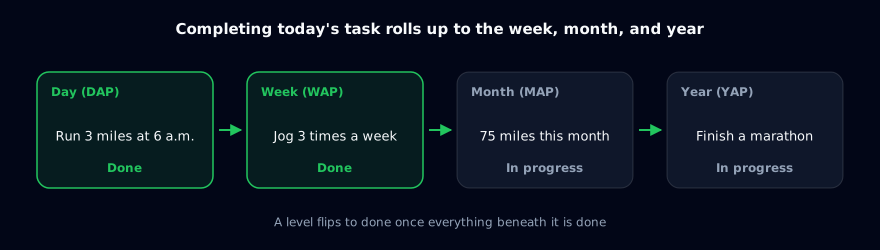
For "run 12 miles across three weekday runs and one weekend run," today's task is a single line: run 3 miles at 6 a.m. "Log the run" rides along the same day, since it takes 30 seconds afterward. Finish today's task and the weekly goal advances; finish the week and the monthly milestone advances; finish the month and the yearly goal gets closer. That upward flow of progress is the reason an annual goal stays visible day to day.
Use a weekly review to keep the annual goal on track
Once the four layers exist, put a 15-minute weekly review on the calendar before you need it. Fifteen minutes is enough if you keep the agenda tight — how to run a weekly review in 15 minutes lays out the exact sequence that fits in the slot.
In the review, check three things.
- How far each weekly goal got, and whether it's done
- If it isn't: was it time, was the goal too big, or did it turn out to be unnecessary?
- What next week's goals are — and whether the monthly milestone itself needs adjusting
Move unfinished daily tasks into next week, but don't carry them over unchanged. Too big means cut it in half; unnecessary means delete it. Repeated untouched carryovers turn the list into homework you never look at.
At month-end, do the same for the monthly milestone and the yearly goal. With a staged split, rewrite the later months to match the pace you actually held. The yearly goal itself should be hard to rewrite — change it often and the finish line moves, and December 31 stops giving you a yes or no.
Make the annual goal breakdown run itself in an app
You can build all four layers on paper, and for the yearly goal and monthly milestones, paper is fine. The friction starts at step 3.
- Weekly goals have to be reallocated across the month, and "today's 1 to 3" rewritten every single day
- Finishing today's task doesn't feed anything back up to the week, month, or year
- When the month rolls over, firming up the next milestone is easy to forget
Abstria is a goal-management app built on exactly these four layers (YAP, MAP, WAP, DAP). Mark today's action done and the status propagates upward on its own: a parent turns complete when everything under it is complete, and in progress as soon as one child is started or finished.
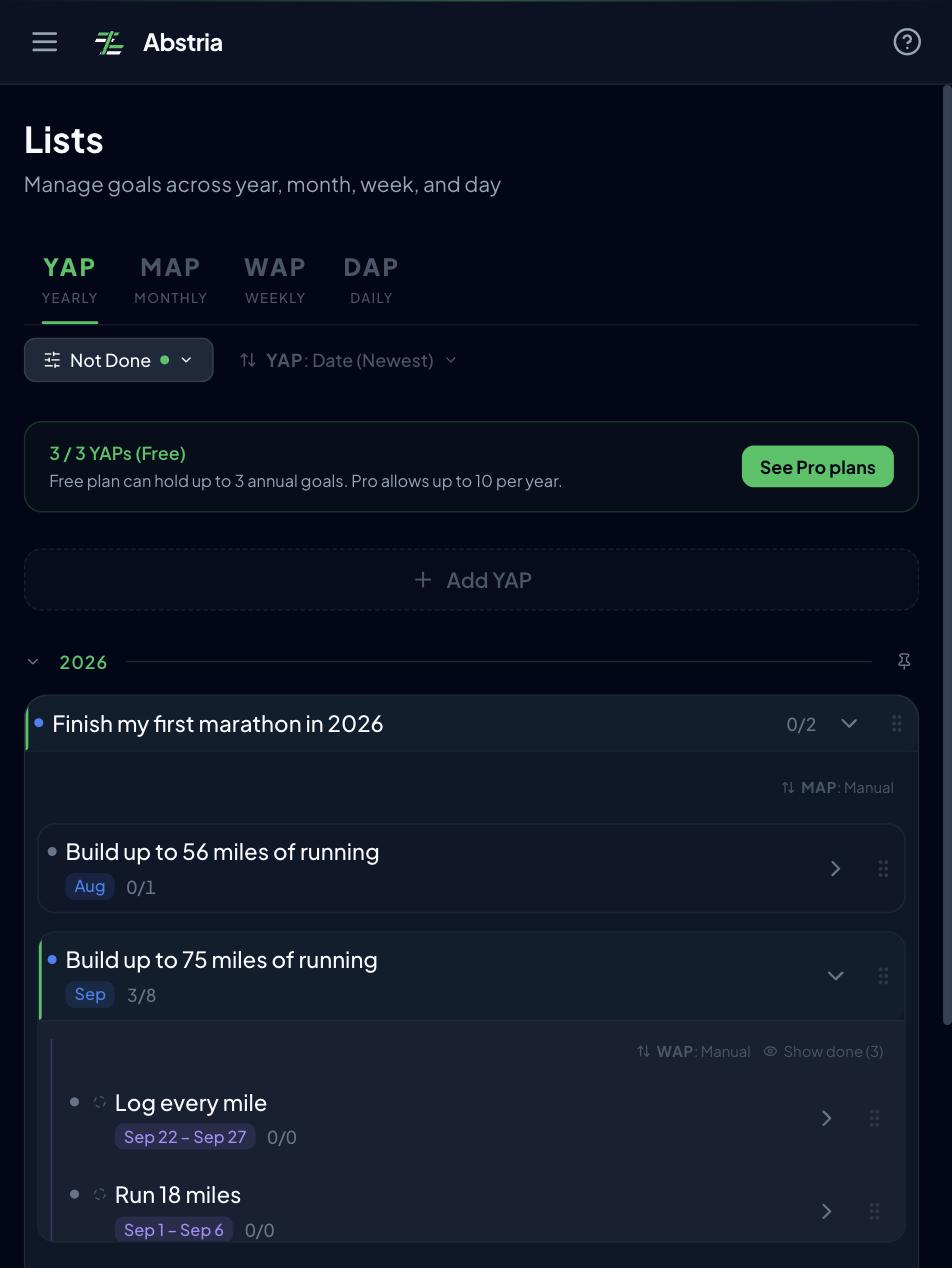
The Free plan holds up to 3 yearly goals and 100 active items (as of September 2026). The four-layer breakdown works identically on Free and Pro, so everything in this article fits inside the free tier. See the pricing page for details.
FAQ
Q. How many annual goals should I set?
Set one to start, and cap it at two or three in different areas once the routine is solid. Each goal needs its own twelve monthly milestones and its own allocation of the eight weekly-goal slots per month, so several at once outruns both the planning and the weekly review. If you do run a work goal alongside a personal one, allocate their weekly slots separately and avoid stacking both deadlines in the same week.
Q. Can I set an annual goal partway through the year?
Yes. The "year" doesn't have to start in January — set the deadline twelve months from today and the same four steps apply. If you want to finish by December instead, divide the milestone across the months you have left; starting in September simply means building four monthly milestones instead of twelve.
Q. What if the goal is too big to break down?
Replace it with the checkpoint you can reach within this year. Goals like "go independent" or "work abroad" span several years and won't divide into twelve months as written. Rewrite them as one sentence about this year — "$1,000 a month in side revenue for three straight months," "one 30-minute meeting run in Spanish" — and steps 2 through 4 work as-is. Keep the long-range goal in a note and pick the next checkpoint at year-end.
Q. Should goals be outcome-based or behavior-based?
Outcomes at the year and week level, behaviors at the day level. If the yearly goal is only a behavior ("run three times a week"), a full year passes with no way to judge what you reached. If today's task is an outcome ("60 miles this month"), you still don't know what to do this morning. Monthly milestones can mix both — a mileage number plus one long run.
Q. What should I use to manage all this?
Anything that shows year, month, week, and day in one place: paper, a spreadsheet, or an app. The one part that rarely survives by hand is rolling daily completions back up into weekly, monthly, and yearly progress, so that's the piece worth handing to a hierarchical tool like Abstria.
You can watch this four-layer breakdown work in your browser, no signup required. A marathon goal comes pre-built across all four levels — mark today's action complete and the week, month, and year update with it.
See a yearly goal break down into months, weeks, and days (free, no signup)
To run your own annual goal in Abstria, request access — the product is invite-only as of September 2026. If you already have an invite code, you can go straight to creating an account.